Inside Kraftwerk's 'The Model': direct injection drum pads, custom step sequencers, and pure 1978 synth engineering. #Kraftwerk #SynthPop #StudioHistory #VintageAudio
The story behind the track
Engineering Kraftwerk's Clean Synth-Pop Blueprint on The Model
How Ralf Hütter and Florian Schneider turned custom analog sequencers, direct-injected synthesizers, and telecommunications gear into a pop hit.
The Rise of Clockwork Pop

In late 1977, Kraftwerk entered their private facility in Düsseldorf to track material for the album Die Mensch-Maschine. The group sought to distill their extended electronic experiments into tight pop structures without abandoning synthesized timbres.
Producers Ralf Hütter (Autobahn – Kraftwerk) and Florian Schneider (Radio-Activity – Kraftwerk) shared performance duties with Karl Bartos and Wolfgang Flür. Hütter handled lead vocals and synthesizers while Bartos and Flür managed rhythm triggers and sequenced bass parts.
The track fused pure electronic sound design with traditional commercial song lengths. While the initial German release arrived in May 1978, the English version topped the UK singles chart years later in early 1982.
The track fused pure electronic sound design with traditional commercial song lengths.
The arrangement · Key and mode
A minor
Intro0:00 - 0:17 · 8 bars
Electronic drum beat starts alongside sequenced synth bass and Polymoog pad chords.
Verse 10:17 - 0:49 · 16 bars
Dry lead baritone vocal enters over sparse bass pulses and crisp electronic snare.
Chorus 10:49 - 1:05 · 8 bars
Soaring Minimoog melodic lead hook takes over above sustained polyphonic string layers.
Verse 21:05 - 1:37 · 16 bars
Vocal narrative returns with subtle filter modulation on electronic hi-hats.
Chorus 21:37 - 2:09 · 16 bars
Melodic hook doubles in length with brighter upper-harmonic synth reinforcement.
Bridge / Interlude2:09 - 2:41 · 16 bars
Arrangement thins down to rhythm, bass pulses, and filtered camera shutter effects.
Chorus 3 / Outro2:41 - 3:38 · Vamp to cold stop bars
Full arrangement repeats the lead melody hook before stopping sharply on a chord.
The song alternates between detached narrative verses and high-register synth themes. Tension builds through expanding synthesizer layers rather than rising vocal delivery. A sparse middle bridge clears space for mechanical sound effects before resolving into the final melodic hook.
Tracking and Assembly Across Düsseldorf

Sessions began at Kling Klang Studio with basic rhythm beds clocked to hardware timing pulses. The group linked a Matten & Wiechers Synthanorma 16-step sequencer directly to a Moog Micromoog synthesizer to establish steady bass runs.
Percussion lines bypassed conventional acoustic kits entirely. Wolfgang Flür played custom metal pads wired to analog tone generators, feeding pristine electronic signals straight to tape without room resonance or spill.
Chief recording engineers Joschko Rudas (Viva – La Düsseldorf; Sommer in der Stadt – Wolfgang Petry) and Leonard Jackson (The Whispers – The Whispers; Big Fun – Shalamar) supervised technical operations, bringing tape reels to Studio Rudas for overdubbing and mix preparation. Assistant engineer Henning Schmitz (Electric Café (Techno Pop) – Kraftwerk) helped maintain signal flow between custom interfaces and commercial consoles.

Florian Schneider constructed mechanical atmosphere by patching white noise bursts through an ARP 2600. Arun Chakraverty completed mastering work in London, cutting hot lacquers that translated the punchy bottom end cleanly onto vinyl.
Wolfgang Flür played custom metal pads wired to analog tone generators, feeding pristine electronic signals straight to tape.
Kling Klang and Studio Rudas
Kling Klang operated as an isolated laboratory in an industrial quarter of Düsseldorf. Ralf Hütter and Florian Schneider eliminated phone lines and daylight to maintain uninterrupted concentration during tracking runs.
Monitoring inside Kling Klang relied on Klein + Hummel OY active speakers. The control desk featured custom Telefunken V72 tube preamplifiers mounted in modular sub-racks to provide clean line-level amplification for electronic sources.
Final mix balances took place at Studio Rudas on a 32-channel Harrison 3232 inline console. The facility maintained a Telefunken M15A 24-track recorder running two-inch tape at 30 inches per second.
Ralf Hütter and Florian Schneider eliminated phone lines and daylight to maintain uninterrupted concentration during tracking runs.
Instruments, then and now
ThenMoog Micromoog
Now
HardwareMoog GrandmotherBehringer Toro
SoftwareTAL-BassLineSurge XT
On a budget: Use any free subtractive monosynth plugin loaded with a single saw oscillator and 24dB low-pass ladder filter.
ThenMinimoog Model D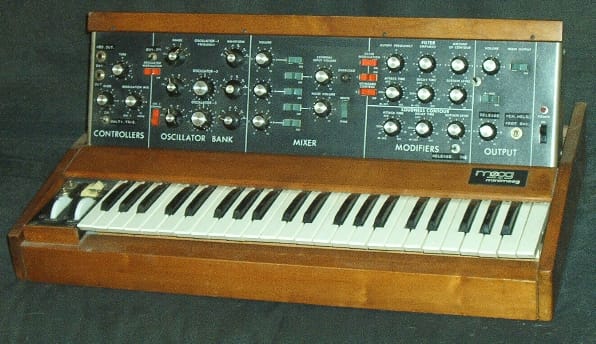
Now
HardwareBehringer Model DMoog Subsequent 25
SoftwareFull Bucket FB-3300Vital
On a budget: Dial two detuned saw waves in a free wavetable synth and set a moderate filter decay.
ThenPolymoog 203a
Now
HardwareNovation Peak
SoftwareFull Bucket DeputyVital
On a budget: Stack narrow pulse waves with gentle chorus on your DAW stock polysynth.
ThenARP 2600
Now
HardwareBehringer 2600Korg ARP 2600 M
SoftwareSurge XT
On a budget: Route a white noise generator through a stock bandpass filter with a 20-millisecond envelope release.
ThenCustom Kling Klang Electronic Drums
Now
HardwareNord Drum 3P
SoftwareTAL-NoiseMaker
On a budget: Trigger simple sine drops and gated white noise bursts using your DAW stock drum sampler.
ThenMatten & Wiechers Synthanorma Sequencer
Now
HardwareKorg SQ-1Doepfer Dark Time
SoftwareVCV Rack
On a budget: Program rigid eighth notes directly inside your DAW piano roll with velocity fixed at maximum.
Producer tip · Stereo Detuned Synthesizer Hook · Works in any DAW
Widening Lead Monosynths Without Chorus Mud
I would start by setting up a subtractive synth patch using three saw oscillators tuned closely together. Send the instrument output into a pitch shifter and split it across the stereo channels. Detune the left channel upwards by three cents and shift the right side down by the same amount. Insert a digital delay with five milliseconds on one side to pull the sound wide without adding phase wash. Follow this with a high-cut EQ to tame piercing top frequencies.
Subtractive synthesizerPitch shifterDigital delayHigh-cut EQ
Deep dive: Dry Lead Vocal Tracking Chain
The lead vocal on The Model cuts through the electronic wall of sound with exceptional clarity. Its dry, forward character sets the dispassionate tone of the entire production.
- Microphone. A Neumann U87 large-diaphragm condenser microphone captured Ralf Hütter in cardioid mode inside an isolated tracking booth.
- Preamplification. The microphone signal passed into a Telefunken V76 console preamplifier, providing transparent gain and flat frequency response.
- Dynamics Control. An EMT 156 pulse-duration modulation limiter controlled vocal transients without introducing audible gain-reduction pumping.
- Multitrack Capture. The compressed signal printed directly to a Telefunken M15A 24-track machine on two-inch tape at 30 inches per second.
- Console Routing. At Studio Rudas, the track returned through a Harrison 3232 channel strip using musical high-pass filtering to clear low-end mud.
- Ambience. An EMT 140 plate reverb supplied a very subtle space, kept low in the mix to preserve vocal dryness.
Use your audio interface built-in preamps paired with stock DAW high-pass filtering and a fast stock compressor set to low ratios.
Modern versions of the gear
Tokyo Dawn Records Kotelnikov
Tokyo Dawn LabsProvides transparent dynamic control with fast peak catching and clean gain reduction.
Analog Obsession BritChannel
Analog ObsessionSupplies clean console preamplification and switchable high-pass filtering.
Valhalla Supermassive
Valhalla DSPCan be dialed down for subtle plate-style vocal diffusion when blend controls are kept low.
Song fingerprints
Hardware Sequencer Bass DriveA Matten & Wiechers Synthanorma sequencer controls the Moog Micromoog via control voltage. The resulting eighth-note bassline stays perfectly locked without human timing drift.
Detuned Lead WideningThe main Minimoog Model D melody routes through an Eventide H910 Harmonizer detuned by three cents. This pitch offset widens the monophonic synth line across the stereo field.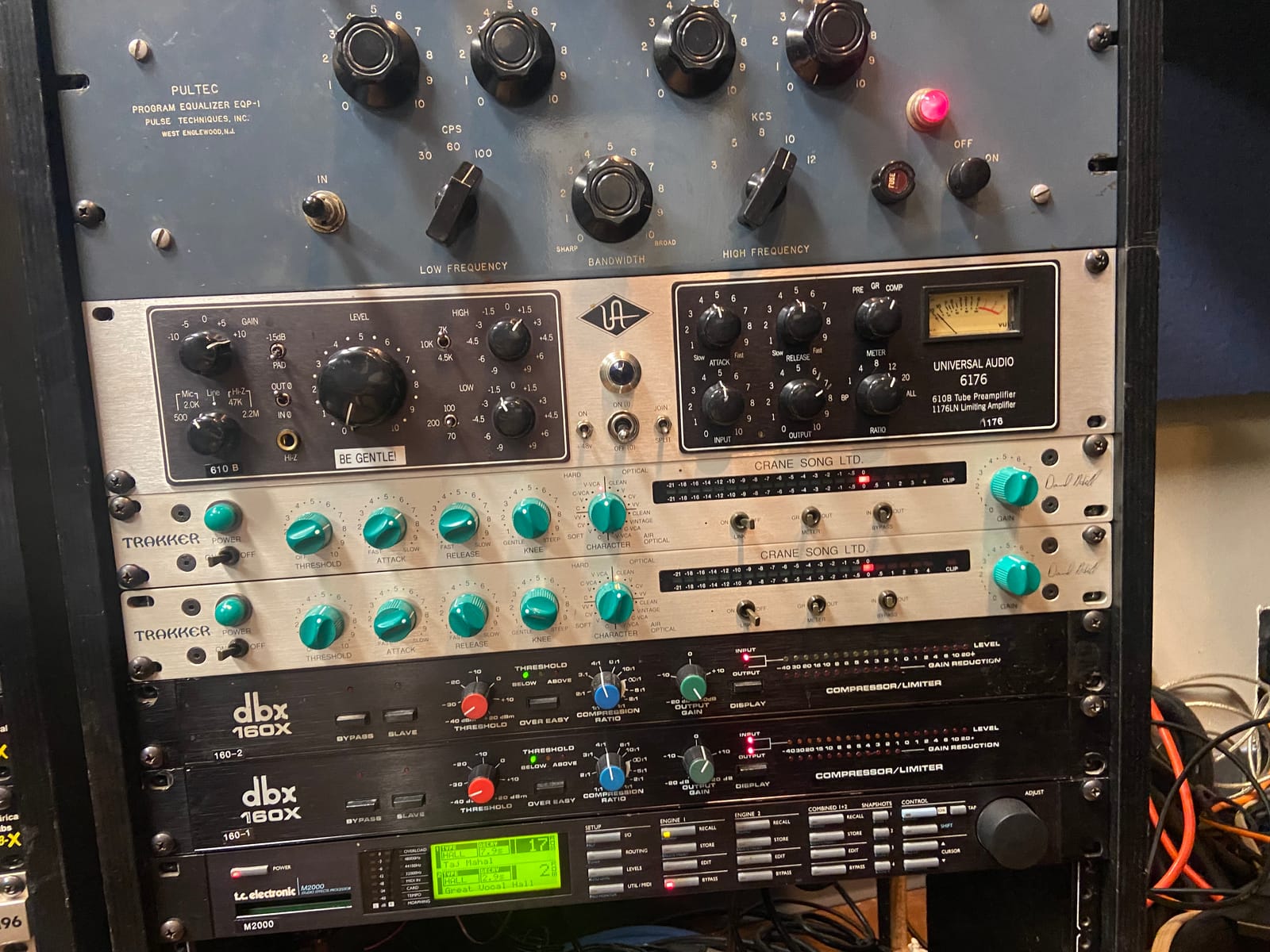 Direct Injection PercussionCustom drum triggers send audio straight through Telefunken V72 modules into DBX 160 units. Tracking synthesizers directly avoids acoustic spill and preserves fast initial transients.
Synthesized Shutter BurstsAn ARP 2600 white-noise generator feeds a fast envelope release into a bandpass filter. The synthesized noise burst closely emulates mechanical fashion camera clicks.
Discrete Transistor Bass FilteringThe Moog Micromoog uses a 24dB resonant low-pass ladder filter. The steep slope keeps sub frequencies tight while removing high harmonic clutter.
Pulse Modulation Dynamic ControlEngineers used an EMT 156 compressor on the electronic snare and vocal tracks. The rapid pulse-duration modulation clamps peaks while keeping transients intact.
High-Speed Tape HeadroomThe band tracked at 30 inches per second on a Telefunken M15A multitrack deck. The high tape speed minimised hiss and maintained clean high-frequency reproduction.
Isolated Vocal Booth TrackingRalf Hütter recorded his dry baritone vocals in a fully isolated Kling Klang booth. The directional capture removed ambient room sound entirely from the multitrack.
Did you know?
- Wolfgang Flür crafted the drum triggers using metal plates and knitting needles to stop acoustic noise bleeding across Kling Klang.
- Kling Klang ran without an internal phone, forcing outside callers to ring a public hallway booth at a prearranged time.
- Studio Rudas engineer Leonard Jackson simultaneously worked on major American R&B and disco records for SOLAR Records.
- Mastering engineer Arun Chakraverty etched his trademark name into the vinyl dead wax at London's Strawberry Mastering.
Share this story
TRACKING AT KLING KLANG
Bypassing acoustic drum kits let Kraftwerk record percussive pulses without microphone bleed.The Model · Kraftwerk
THE HARDWARE
A three-cent detune on an Eventide H910 turned a simple Minimoog lead into a wide stereo hook.The Model · Kraftwerk
SIGNAL FLOW
The entire rhythm section ran via control voltage from a custom sixteen-step analog sequencer.The Model · Kraftwerk
instagram
x
How Kraftwerk tracked 'The Model': Moog Micromoog bass clocked by custom hardware sequencers straight to a Telefunken M15A. No acoustic bleed, no room mics. #Kraftwerk #MusicProduction
tiktok
The secret behind the camera clicks on Kraftwerk's The Model? It's not a real camera, but an ARP 2600 synth pushing white noise bursts. #MusicProduction #SynthTok #Kraftwerk
facebook
Before 'The Model' topped the UK charts, Kraftwerk engineered its clinical sound at Kling Klang and Studio Rudas using custom direct-injection percussion and the Minimoog Model D. #Kraftwerk #Synthesizers #StudioProduction